Tipping Around the World: What's Expected in 20+ Countries
A country-by-country tipping guide covering when tips are expected, when they're offensive, and how much to leave in 20+ destinations worldwide.
- tipping by country
- international tipping
- travel tips
- tipping etiquette
Disclaimer: Tipping customs vary; the amounts in this article reflect commonly cited norms for each country, not legal requirements. Customs change over time and can differ within regions of the same country.
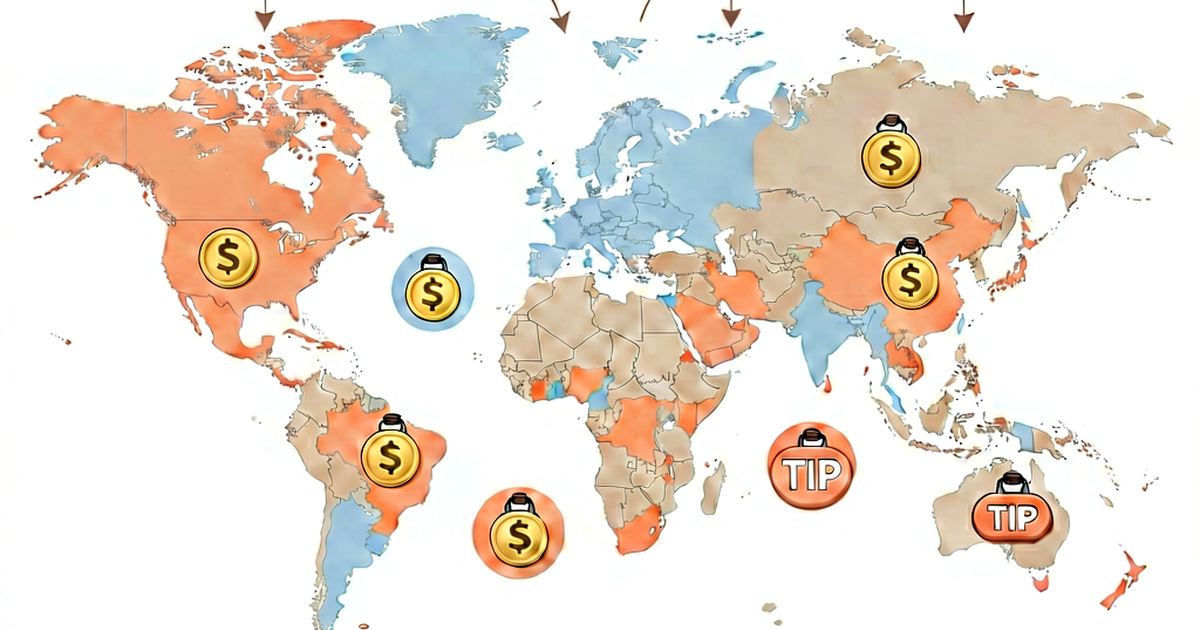
If you tip as generously abroad as you do in the United States, you may insult your waiter. If you follow Japanese etiquette in Mexico City, you’ll leave your server short. Tipping customs are deeply cultural — what is polite in one country is rude or confusing in another.
This guide covers 20+ countries with clear guidance on whether to tip, how much, and any local nuances to know. When you return home, use our tip calculator for US restaurant tipping.
The Four Tipping Categories
Most countries fall into one of four buckets:
- Expected (US-style): Tipping 15–20% is the social norm; not tipping is considered rude
- Appreciated but modest: 5–10% or rounding up is appreciated; not expected at US levels
- Not customary: Service staff are paid living wages and a tip may create awkwardness
- Can be considered rude: In some cultures, tipping implies the person’s wages are insufficient or their hospitality was transactional
Country-by-Country Guide
North America
| Country | Restaurant | Taxi | Hotel Housekeeping | Notes |
|---|---|---|---|---|
| United States | 18–20% | 15–20% | $2–5/night | Expected; tipped workers earn sub-minimum base wages |
| Canada | 15–20% | 15% | $2–3/night | Very similar to the US; service charge sometimes added |
| Mexico | 10–15% | Round up or 10% | 20–50 pesos/night | Expected at tourist-facing restaurants; always appreciated; pay in local currency when possible |
Western Europe
| Country | Restaurant | Notes |
|---|---|---|
| United Kingdom | 10–15% if service charge not added | Check the bill — many UK restaurants add a 12.5% service charge automatically. If it’s already there, you don’t need to add more. Cash tips go directly to the server more reliably. |
| France | Round up or leave small change (5–10%) | Service compris is legally included in restaurant prices; a small extra tip is a sign of appreciation, not an obligation |
| Germany | Round up or 5–10% | Tip the server directly in cash; don’t leave it on the table. “Stimmt so” means “keep the change.” |
| Italy | Small change; 5–10% at sit-down restaurants | Coperto (cover charge) is standard and separate from a tip. Leaving a few coins to a euro or two per person is appreciated but not obligatory. |
| Spain | Round up; 5–10% appreciated | Tipping is less ingrained than in Northern Europe; a few coins to 5% is typical |
| Netherlands | Round up; 5–10% | Not as ingrained as the UK; rounding up is appreciated |
| Switzerland | Service charge usually included; leave 5% if exceptional | Swiss service staff earn high wages; tips are genuinely optional |
Northern Europe
| Country | Restaurant | Notes |
|---|---|---|
| Sweden | Not customary; rounding up is fine | High base wages; tipping is becoming slightly more common in cities due to US influence, but not expected |
| Norway | Not expected; 5–10% for excellent service | Same as Sweden — strong base wages, low tip culture |
| Denmark | Not expected | Service is considered covered in the price |
| Finland | Not expected | Tips are very unusual; not leaving one is not rude |
Eastern Europe
| Country | Restaurant | Notes |
|---|---|---|
| Poland | 10% | Tipping is common and appreciated in restaurants; less so at cafés |
| Czech Republic | 10% | Round up or leave 10% at sit-down restaurants; Prague’s tourist areas have adopted more US-like expectations |
| Hungary | 10–15% | Tips are expected in restaurant service; hand the tip directly to the server |
Asia
| Country | Restaurant | Notes |
|---|---|---|
| Japan | Not customary — can be offensive | This is the most important rule in Japanese travel. Tipping implies the server’s wage is not enough for dignified work. Staff may run after you to return your tip. No tipping at restaurants, taxis, or hotels in most contexts. Ryokan (traditional inns) have a separate, formalized gift-giving custom (oshibori). |
| South Korea | Not customary | Similar to Japan — tips are not expected and can be awkward in traditional settings; some Westernized restaurants in Seoul may be more receptive |
| China | Not expected in traditional settings | Tourist-facing restaurants in major cities have become more accustomed to tips; traditional settings, no |
| Thailand | 20–50 baht at restaurants (approx. $0.60–$1.50); 10% at nicer tourist venues | Service is often included. Keep small coins/bills for tipping. |
| India | 10% at restaurants; 20–50 rupees for other services | Service charge is sometimes added at nicer establishments; tipping is appreciated and expected at tourist-facing restaurants |
| Indonesia / Bali | 10% if service not included | Check the bill; many restaurants add a service charge. If not, a 10% tip is appreciated. |
Middle East
| Country | Restaurant | Notes |
|---|---|---|
| UAE (Dubai, Abu Dhabi) | 10–15% if not included | Bills in tourist areas often include a service charge; if not, tipping is appreciated |
| Egypt | 10–15%; always carry small bills (baksheesh) | Tipping (baksheesh) is a deeply ingrained part of service culture; carry small denomination bills constantly |
| Israel | 10–15% | Service charge is not always included; tipping is expected at restaurants |
Australia and New Zealand
| Country | Restaurant | Notes |
|---|---|---|
| Australia | Not required; 10% appreciated for good service | Australian servers earn a living wage (~AUD $25+/hour); tipping is not built into the system. A small tip is a genuine gesture of appreciation, not an obligation. |
| New Zealand | Similar to Australia | Appreciated but not expected; rounding up or $5–10 on a larger bill is fine |
Latin America
| Country | Restaurant | Notes |
|---|---|---|
| Brazil | 10% (often added as service charge) | Check if “taxa de serviço” appears on the bill; if not, 10% is standard |
| Argentina | 10% | Tip in cash when possible; economic volatility makes cash tips in local currency preferred |
| Colombia | 10% (optional “propina voluntaria”) | By law, Colombian restaurants must ask if you want to add the 10% service charge; it is optional but normal to accept |
Key Takeaways
- Japan and South Korea: Do not tip. It is considered impolite.
- Northern Europe (Sweden, Norway, Denmark, Finland): Tips are not expected; rounding up is fine.
- Western Europe (UK, France, Germany, Italy): Modest tips or rounding up is appreciated; check whether a service charge is already on the bill.
- US, Canada, Mexico: Tips are expected and meaningful to service workers.
- Always carry local currency in small denominations — even in countries where tipping is modest, card-based tipping is not always possible.
Before traveling, check a current travel guide for your specific destination — customs evolve, and regional variation within a country can be significant.
Use our tip calculator for US restaurant tips whenever you’re back home.
Related reading
-
How Much to Tip a Server: The Complete Guide
Standard tip percentages for restaurants, what factors should change your tip, and the tipped minimum wage context that explains why tips matter.
-
Tipping Etiquette in the United States: A Service-by-Service Guide
How much to tip at restaurants, bars, hotels, taxis, salons, and more — a complete service-by-service tipping guide for the US.